
Ruaithehna: Community Feasting in Mizoram
As the old Mizo saying goes, “Sem sem dam dam, ei bil thi thi”, which roughly translates to
“Share share live live, eat alone die die.” Whether folklore or everyday life, food — and
more specifically, sharing food — has remained integral for the Mizo community since pre-modern
times, when brave men would hold lavish feasts after their hunt to feed an entire village – a
prerequisite to be named an esteemed ‘thangchhuahpa’.
This ICH practice was documented during the second edition of ‘The Great Himalayan Exploration’
in December 2023.

The origin of the Mizo harvest festival “Chapchar Kut” is often associated with the practice of hunting, calling for a variety of meat dishes to continue being served as the main features of modern feasts, known locally as ruaithehna. But perhaps, the most-awaited feast in today’s Christian-dominated Mizoram would be the Christmas ruaithehna, followed closely by New Year’s. Be it large-scale festive events or private celebrations, traditional community feasts are still performed with the same spirit and anticipation, with only a few rules being bent.
“Chaw i ei tawh em?,” (Have you eaten?) Neighbours peering over walls and acquaintances passing by are seen greeting each other in the early hours at Mizoram. Perhaps, these pleasantries evolved as a response to the collective memory of the disastrous famines of the past, when even warring chiefs put behind their enmity, working together to feed the community. In fact, the origin of the more formal greeting “Chi-bai” points to the local food history characterised by generosity even in the face of hardship and scarcity. With “chi” or salt being an extremely rare commodity at the time, and the quintessentially Mizo dish “bai” being incomplete without this ingredient, together, “Chi-Bai” implies that a Mizo would readily serve up the most valuable ingredient in their home as a tribute to their guest.
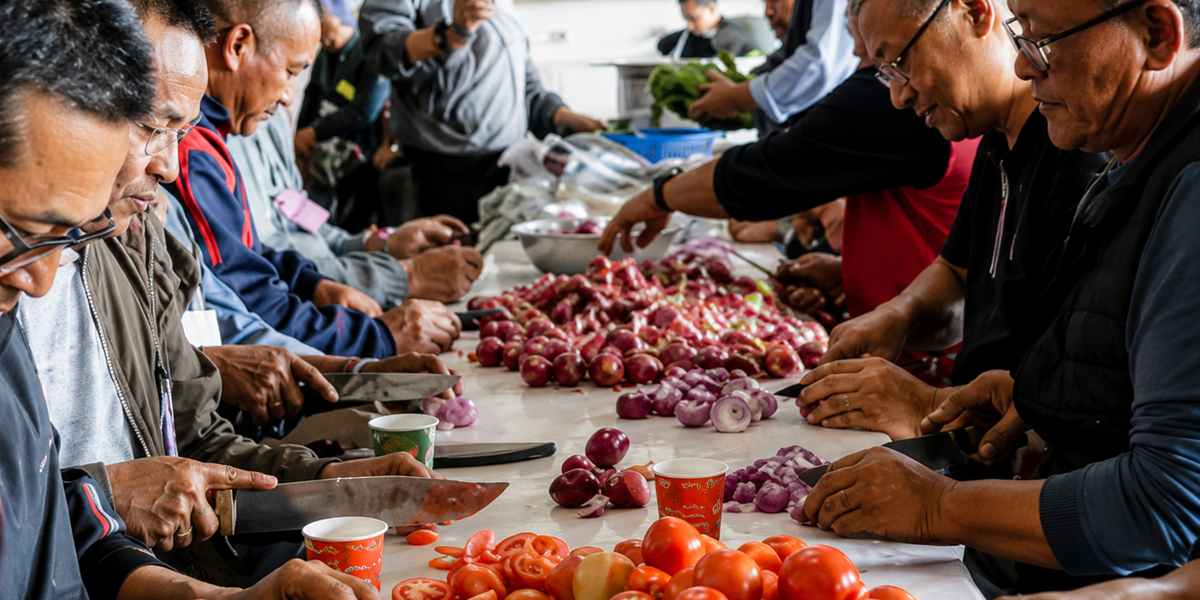
On the day after Christmas, residents of Khatla, like in every other locality of Aizawl, teeter down the steep slopes towards their church in groups — some with friends and others with family members. At the venue, local delicacies are being prepared on an industrial scale — large pots of pork, beef, chicken and fish curry simmer away as women seated on the floor chop seasonal vegetables for salads and other side dishes and chutneys. Leading up to Christmas, all families pool in money for the feast and volunteers organise themselves to prepare, cook and serve the food. In villages and localities where feasts are still prepared the traditional way, designated cooks, known as ‘fatus’, are made up of men – a peculiarity in Mizo society where women usually take up the role of cooking at home. These ‘fatus’ have been trained by the generation of expert cooks before them and use this occasion to pass on recipes and training to younger men. Some neighbourhoods in urban areas, such as Aizawl, have adopted the buffet style of feasting — with local restaurants and catering On the day after Christmas, residents of Khatla, like in every other locality of Aizawl, teeter down the steep slopes towards their church in groups — some with friends and others with family members. At the venue, local delicacies are being prepared on an industrial scale — large pots of pork, beef, chicken and fish curry simmer away as women seated on the floor chop seasonal vegetables for salads and other side dishes and chutneys.