
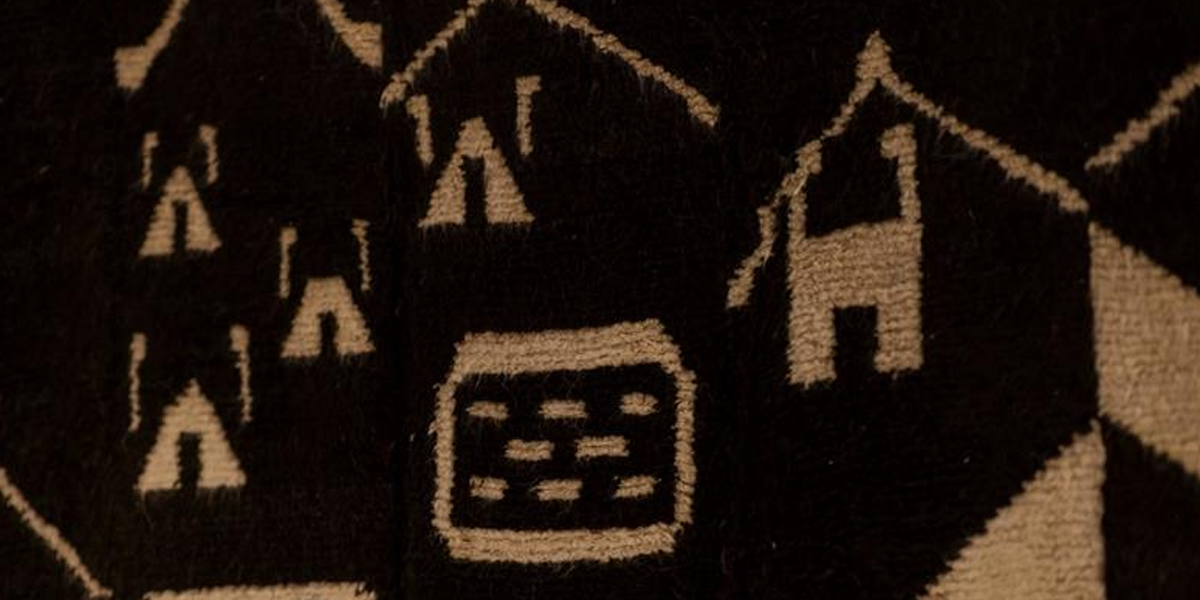
A visual rhetoric, textiles in the Himalayan tradition serve as canvases for recording myths and legends, sharing folktales, and passing on values and systems from one generation to the next.

In the northern and northeastern stretches of India, textiles are living expressions of oral storytelling, cultural values, and community identity. Across these geographies, mythologies explain why women weave. In a tale recounted in Ladakh, demons once roamed the earth causing destruction. A lama, in an attempt to pacify them, taught the male demons religion – but the female demons remained untamed. So, he taught them to weave, and through the act of weaving, they transformed into women. But they had to keep weaving – or risk becoming demons again. This story, both cautionary and powerful, reveals how craft can be used to encode moral instruction, reinforce gender roles, and enshrine the domestic as a stabilising force in society.
Among the Tangkhul Nagas of Manipur, the intricate traditional textile Zingtai Kashan was born of a legend where a fairy taught a gifted girl, Mansingla, the sacred designs that define their textiles today. In another tale, Yonangla Kashung Philava dreamt the recipe for the dye of the Luirim Kachon textile. Even today, these textiles become devices for transmitting stories, marking identity, and capturing histories that have never been written down.
Among the Bodo of Assam, weaving is traced to two fairy sisters, Asagi and Bwisagi, who drew motifs from nature, ferns, pigeon eyes, and the wink of a peacock. The Dokhona, a traditional wrap worn by Bodo women, contains these designs, where each hue has its own identity and even the near absence of black itself becomes a cultural code.
In Himachal Pradesh, the Tsug-den rugs carry symbols like dragons and snow lions – ancestral guardians that narrate tales of Tibetan craft heritage and embody values of protection and power. In Kashmir, Namda felted carpets, said to have been brought by the Sufi saint Shah-e-Hamdan, are steeped in the pastoral life of Himalayan shepherds, speaking to the folk intimacy with the land.
Similarly, the Loi shawl of Uttarakhand tells a story of pastoral life and emphasises local hospitality. Woven by hands calloused with labour and dyed in earthy hues, the Loi is offered to guests as a gesture of warmth, used by shepherds as a protective second skin and treasured in village homes for generations.