
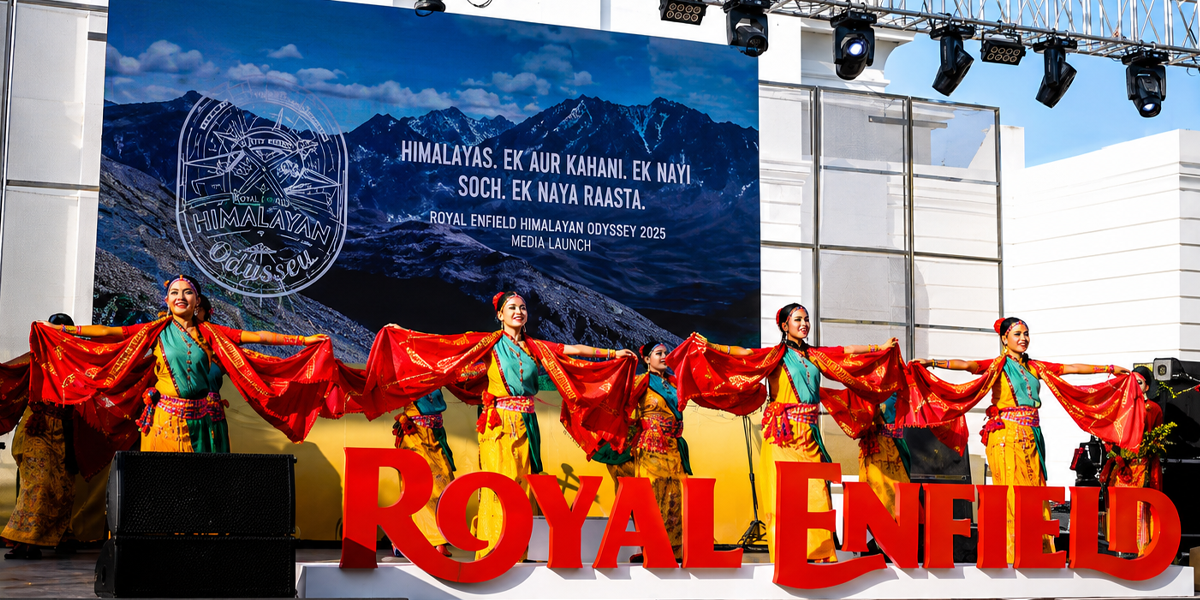
The folk performance troupe from Assam, who sang and danced their way into the audience’s hearts at Journeying Across The Himalayas 2024, is not only preserving its traditions but also transforming it for an inclusive and progressive future.
It was the early days of winter in Delhi, but springtime bloomed in the courtyard of Travancore Palace on day four of the festival. Twenty members of the Sifung Harimu Afad were on stage, performing the Bagurumba Mwsanai, also called the butterfly dance, the main traditional dance of the Bodo community of Assam. Traditionally performed in spring, it symbolises renewal, joy, and harmony with nature. The lyrics of Bagurumba Mwsanai reflect the camaraderie of Bodo women, who gather after a long day in the fields to tease, share stories and celebrate their solidarity through choreography and movement.
The Sifung Harimu Afad (SHA) is a performing arts troupe based out of Rowmari in Bodoland, initiated with the support of the Chirang-based NGO The Action Northeast Trust (The ANT). Since 2014, they have been on a mission to revive Bodo folk music, dance and drama, training nearly 1,000 young talents and inspiring cultural pride. Led by Bodo youth, the Sifung troupe has turned the community’s fading traditions into a vibrant movement with performers now shining at district, state and national platforms. They also have the support of the Royal Enfield Social Mission, which partners with cultural practitioners through partner NGOs to strengthen heritage-based livelihoods. The group’s work goes beyond performance, creating a sustainable future for Bodo dance and music.
The troupe’s performance at the festival referenced the rhythm of daily life in Bodo villages, the energy of seasonal celebrations and the grace of dance traditions passed down through generations. It presented a dynamic blend of Bodo dance forms including, for instance, the Bwisagu Mwsanai which marks the arrival of the Bodo New Year in mid-April during the Bwisagu festival. An expression of gratitude and new beginnings, it celebrates endless possibilities of the year ahead. The troupe also performed the Na Gurnai Mwsanai, a dance that depicts Bodo women fishing with traditional tools like jekai and kobai. Centred on a communal activity where women come together at dawn, cha"er while fishing and rush home at sunset to prepare meals for their families, it celebrates shared labour, resilience and the unseen rhythms of life. Their costumes, intrinsic to the performances, played a key role in storytelling – the patterns of the jwmgra (scarf) evoking images of butterflies, warriors and agricultural life. Each movement, whether a leap mimicking a butterfly's flight or a synchronised step reflecting collective labour, was deeply symbolic. Even as their dance evolves with time and local cultural influences, SHA is focused on restoring traditional steps, ensuring consistency across regions while staying true to historical forms.
Formed under the aegis of The Ant, SHA was set up with the aim to revive Bodo music and dance—increasingly replaced in recent years by technology and popular entertainment—and popularise it among the youth. The initiative follows a “Learn, Do, Teach” philosophy – an approach that has not only promoted tradition but also sparked a quiet transformation within the community. Most SHA members are the first in their families to receive formal training in Bodo dance and music. They are also transcending gender barriers, with women as both musicians and dancers. In a culture where women were once discouraged from touching the instruments that defined their identity, a few dared to challenge the notion that a woman’s place was solely on the dance floor, proving that excellence in playing the Kham, Sifung, and Serja was not a question of gender but of passion and perseverance.
Early attempts were met with skepticism and resistance – a belief so entrenched that some feared the act of a woman playing an instrument could “ruin” its sanctity. Still, as these women persisted, the tide of public opinion began to shift. With each performance of the ancient art form, they paved the way for future generations to embrace a progressive outlook that would only enrich their cultural heritage.
Extending beyond performance, SHA is also involved in reviving the art of crafting traditional instruments, some of which are pending GI (Geographical Indication) certification. With the number of skilled artisans dwindling, the group has taken up the mantle to ensure that the sounds of musical instruments such as the sifung—with its five holes symbolising the elemental forces of nature—continue to resonate. Enabling the practice of the kham (drum), serja (string instrument similar to a violin), and other instruments, these efforts ensure that the musical backbone of Bodo culture remains vibrant and accessible.